Best Buy Is Betting on TikTok Shop. Here’s Why It Matters
September 30, 2026


TikTok Shop built its reputation on viral products, creators and impulse purchases.


Now it wants something bigger.


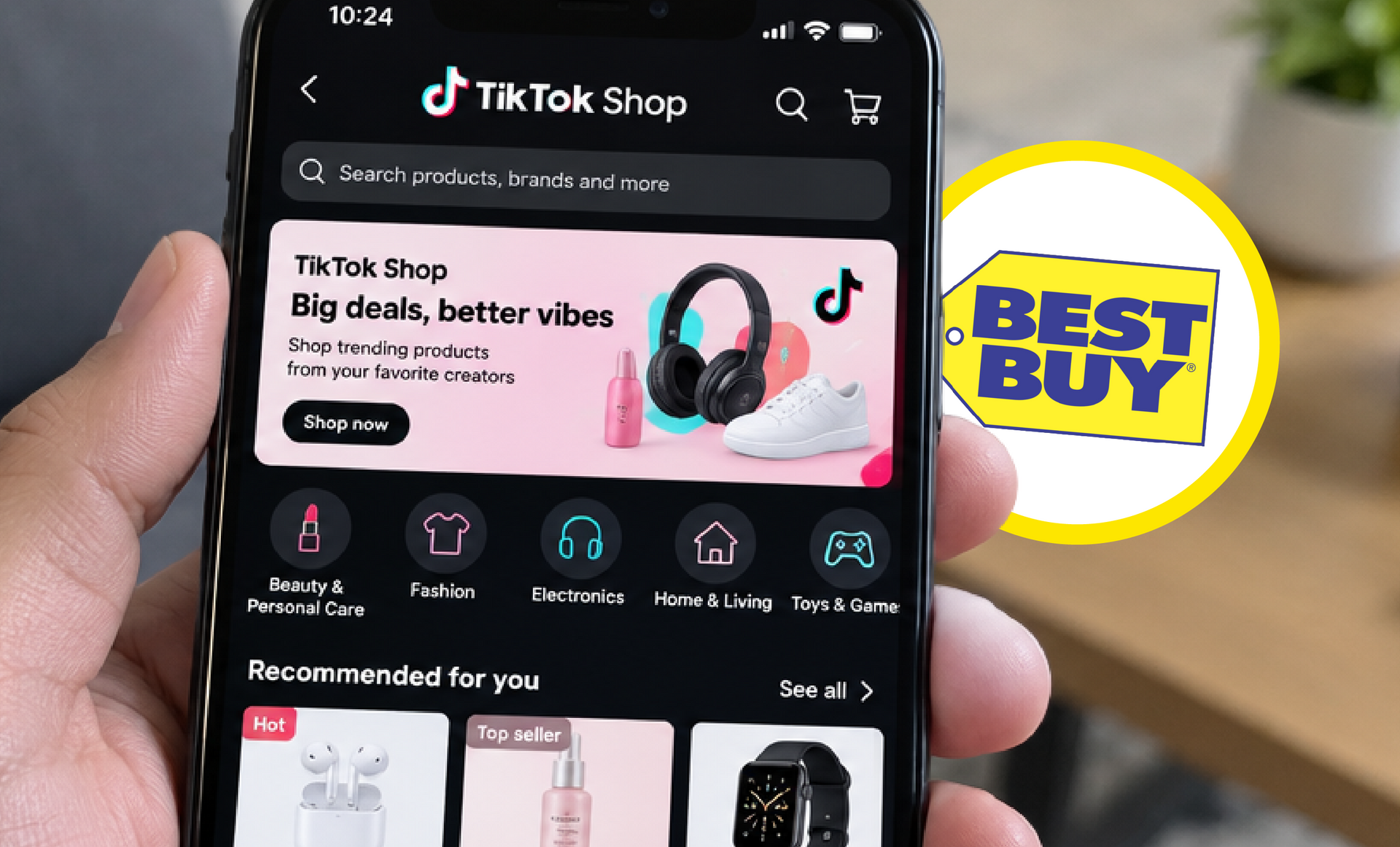
Best Buy plans to bring nearly 10,000 products to TikTok Shop, giving shoppers another way to discover and purchase electronics without leaving the platform.


And Best Buy isn't arriving alone.


Major retailers and brands are increasingly appearing on TikTok Shop, while TikTok itself continues adding features that make the platform look less like a social network with shopping attached and more like a full ecommerce marketplace.


The interesting part isn't simply that another retailer has opened another online storefront.


It's what happens when content, product discovery and commerce all start happening in the same place.


Best Buy Is Bringing Thousands of Products to TikTok Shop


Best Buy plans to launch nearly 10,000 products on TikTok Shop in late October.


That means someone watching TikTok could discover a Best Buy product through a creator, video or TikTok's shopping experience and purchase it without having to leave the platform.


For Best Buy, that's another sales channel.


But it's also access to a very different kind of shopping environment.


Amazon, Google and traditional ecommerce sites tend to capture customers who already have some idea of what they're looking for.


Someone searches for headphones because they need headphones.


TikTok can introduce the product before that intent exists.


A customer might open the app with absolutely no intention of shopping, see a creator demonstrating a pair of headphones and decide they want them.


That distinction is important.


TikTok isn't simply trying to make online shopping easier. It's trying to turn product discovery itself into part of the shopping experience.


And It's Not Just Best Buy


Best Buy's arrival makes more sense when viewed alongside the other retailers moving onto the platform.


Sephora joined TikTok Shop in September, while Ulta Beauty had already joined earlier in the year.


TikTok has been actively working to attract larger, established retailers as it tries to broaden the perception of what people can buy through the marketplace.


That's significant because TikTok Shop initially became associated with a particular type of ecommerce: viral products, aggressive discounts, creator promotions and inexpensive impulse purchases.


Bringing recognized retailers onto the platform changes that equation.


The more familiar brands and established merchants consumers encounter, the more TikTok Shop can begin to look like somewhere people deliberately go to shop rather than somewhere they occasionally happen to buy something.


TikTok Shop Is Changing Its Image

This is arguably the larger story behind Best Buy's move.


TikTok already has something traditional marketplaces spend enormous amounts of money trying to acquire:

attention.


Millions of people are already opening the app to watch content.


TikTok Shop allows the platform to connect that attention directly to commerce.


A creator can introduce a product.


A video can demonstrate it.


Comments can provide immediate social proof.


The customer can then purchase the product without leaving the platform.


Discovery, marketing and checkout begin collapsing into the same experience.


That removes several of the steps businesses have traditionally needed to move a customer through.


Instead of attracting someone on one platform, sending them to another website and hoping they eventually purchase, TikTok can potentially contain much of that journey inside a single ecosystem.


TikTok Is Even Building Its Own Version of Prime


TikTok's ambitions become even clearer when looking beyond individual retailers.


The company has introduced TikTok Shop Plus, a paid membership program offering benefits such as free shipping, member discounts and coupons.


The comparison with Amazon Prime is difficult to ignore.


Membership benefits give customers another reason to shop repeatedly through the platform rather than treating TikTok Shop as somewhere they make the occasional impulse purchase.


For TikTok, that could help create shopping habits.


And shopping habits are what turn a sales feature into a marketplace.


TikTok Has One Major Difference


TikTok doesn't need to become Amazon to become a major force in ecommerce.


Its biggest advantage may be that it starts from a completely different place.


Amazon usually begins with intent.

“I need headphones.”

TikTok can begin with discovery.

“I wasn't looking for headphones, but a creator just showed me a pair I want.”


That combination of entertainment, creators and product discovery gives TikTok Shop a different role in the buying journey.


Traditional ecommerce has spent years optimizing search, product pages and checkout.


TikTok introduces another variable: the content itself can become the storefront.


A successful video isn't necessarily just advertising that sends someone somewhere else.


It can create the demand, demonstrate the product, provide social proof and lead directly to a transaction.


Content Is Becoming the Storefront


That has implications well beyond companies the size of Best Buy.


Businesses have traditionally treated content and ecommerce as separate functions.


Marketing generates attention.


The ecommerce store converts it.


Social media builds an audience.


The website makes the sale.


TikTok Shop increasingly blurs those boundaries.


A creator video can be advertising, product demonstration, recommendation and storefront at the same time.


For businesses selling products online, that means the question may eventually become less about whether TikTok is another social media channel worth posting on.


The more important question could be whether content-led commerce belongs in the company's overall ecommerce strategy.


This Is Bigger Than Another Sales Channel


It's easy to look at Best Buy joining TikTok Shop and see another retailer expanding onto another marketplace.


But the underlying shift is more interesting.


TikTok can increasingly operate as several things simultaneously:


A marketing channel.
A creator network.
A product discovery engine.
And a marketplace.


That combination is difficult to replicate because TikTok doesn't need customers to arrive specifically intending to shop.


Commerce can appear naturally inside the experience that brought them there in the first place.


Best Buy bringing thousands of products onto the platform is another indication that this model is moving beyond small sellers and viral products.


Established retailers are paying attention too.


The Line Between Content and Commerce Is Disappearing


For years, businesses have built funnels designed to move people from discovery to purchase.

See the ad.


Visit the website.


Browse the products.


Read the reviews.


Add something to the cart.


Check out.


Social commerce compresses that journey.


The content that introduces a product can increasingly become the place where the customer buys it.


Best Buy joining TikTok Shop isn't interesting simply because another storefront is opening.


It's another sign that where people discover products and where they buy them are becoming the same place.


And that could change much more than where businesses choose to list their products.

October 26, 2026
Marketing is becoming more technical. As businesses adopt AI tools, automation and increasingly complex software, a new kind of specialist is emerging: the marketing engineer. For years, businesses have built marketing teams around familiar responsibilities: advertising, content creation, search engine optimization, social media and lead generation. Those responsibilities haven't disappeared. But the technology behind them has become increasingly complicated. Businesses now rely on advertising platforms, customer relationship management systems, email automation, website analytics, e-commerce software and AI tools. Making those systems work together is becoming an important part of marketing performance. That's where the marketing engineer comes in. What Is a Marketing Engineer? A marketing engineer combines marketing knowledge with technical skills. Traditional marketing specialists might develop a campaign strategy, create content or manage advertising budgets. A marketing engineer can help build the technical systems that make those activities more effective. That might involve connecting a CRM to advertising platforms, automating reporting, improving conversion tracking, integrating customer data or developing workflows using APIs and AI tools. The role connects marketing strategy with technical execution. Rather than relying entirely on separate developers, analysts and software specialists, businesses can use technical marketing expertise to bridge those functions. The Problem With Disconnected Marketing Systems Many businesses already have the technology they need. The challenge is getting it to work together. A company might use Google Ads to attract customers, Shopify to process orders, Klaviyo for email marketing and a CRM to manage relationships. Each platform collects information, but that doesn't necessarily mean the information is connected. Employees may still need to download reports, transfer leads between systems, update spreadsheets or manually compare campaign results against actual sales. Those disconnected processes can make marketing slower and more difficult to measure. Marketing engineering focuses on improving the connections between systems. When information moves reliably between platforms, businesses can reduce repetitive work and make decisions using more complete data. AI Search Is Changing How Businesses Get Discovered Technical marketing is also becoming more relevant as AI-powered search develops. Traditional search engine optimization focuses on helping websites appear in organic search results. But customers increasingly use AI-powered tools to research products, compare services and find answers. That has brought greater attention to two related concepts. Answer Engine Optimization (AEO) focuses on making information clear, accessible and useful for answer-based discovery. Generative Engine Optimization (GEO) focuses on improving how content can be discovered, understood and potentially referenced by generative AI systems. These approaches overlap with established SEO practices, including technically accessible websites, useful content and clear information architecture. They do not guarantee inclusion in AI-generated answers. For businesses, the practical lesson is that website content and technical structure need to support more than traditional search rankings. Automation Can Eliminate Repetitive Marketing Work Another opportunity is workflow automation. Marketing departments often spend considerable time on tasks that don't require much creative judgment. Downloading reports, updating spreadsheets, transferring customer information, preparing campaign summaries and moving data between applications are common examples. Many of these activities can be automated when systems are properly connected. That doesn't eliminate the need for marketers. It can give them more time to focus on strategy, creative development, customer relationships and improving campaign performance. The objective isn't to automate everything. It's to identify which tasks can be handled more reliably and efficiently through technology. Better Data Can Lead to Better Marketing Decisions One of the biggest challenges in marketing is understanding which activities actually contribute to revenue. A campaign might generate thousands of impressions, hundreds of clicks and dozens of leads without producing profitable customers. Marketing engineers can help businesses connect advertising activity with customer and sales information. That includes improving conversion tracking, integrating data sources and identifying where potential customers drop out of the buying process. The goal is to move beyond reporting what happened on an advertising platform and develop a clearer understanding of what happened across the business. Does Your Business Need a Marketing Engineer? Not every company needs to hire a full-time technical marketing specialist. For smaller businesses, the first step is identifying where disconnected systems, manual processes or unreliable data are creating problems. Consider whether your advertising and sales platforms share information, whether campaign performance can be connected to revenue and whether repetitive reporting tasks could be automated. It is also worth reviewing whether your website is technically accessible, well structured and capable of answering the questions potential customers are asking. Depending on the complexity of the business, these improvements might be handled by an internal employee, an outside specialist or a combination of both. The important decision isn't necessarily who to hire. It's determining which capabilities the business actually needs. The Future of Marketing Is More Connected Creative thinking, compelling messaging and customer relationships remain essential to effective marketing. But those strengths increasingly depend on the technology supporting them. Businesses need systems that communicate, data that can be trusted and processes that allow teams to work efficiently. Marketing engineering represents one approach to bringing those capabilities together. The next competitive advantage may not come from producing more content or launching more campaigns. It may come from building a marketing operation where everything works together.
October 23, 2026
Procter & Gamble didn't simply outsource its support operations. It first rebuilt how they worked, then brought in outside partners. By 2008, its business-services transformation had generated approximately $600 million in cumulative savings. In the late 1990s, Procter & Gamble faced a problem familiar to businesses of almost every size: too many teams performing similar work. Finance, human resources and other support functions were spread across different parts of the company. That meant duplicated activities, inconsistent processes and unnecessary costs. Instead of continuing to expand those departments independently, P&G decided to fundamentally change how its business operated. First, P&G Fixed Its Internal Operations In 1999, P&G began bringing its support functions into a single global organization. Over the following three years, the company consolidated and standardized more than 70 services. It also established shared-service centers to support operations around the world. The goal was to replace fragmented systems with a more consistent and efficient operating structure. Importantly, P&G didn't begin by handing all these functions to outside companies. It first reorganized how the work was performed internally. That foundation would make the next phase possible. Then Came $4.2 Billion in Outsourcing Agreements In 2003, P&G entered into outsourcing partnerships valued at approximately $4.2 billion. Outside specialists took responsibility for selected operations, including IT infrastructure, payroll support, accounts payable and facilities management. Rather than maintaining every capability internally, P&G could rely on partners with specialized expertise, established systems and the scale to manage these activities. But it didn't outsource everything. The company retained control of functions it considered strategically important, including procurement, logistics, IT architecture and technology-driven innovation. This distinction was central to the strategy. P&G wasn't trying to eliminate internal operations. It was deciding which activities made sense to manage itself and which could be handled more effectively by partners. The Benefits Went Beyond Cost Savings One of the clearest examples came during P&G's integration of Gillette. According to P&G's business-services leadership, its established systems and outsourcing partners helped the company mobilize approximately 750 additional people within weeks. The business-services integration was completed in 15 months, a process its leadership believed could otherwise have taken three to four years. That flexibility mattered. P&G could draw on existing capabilities and outside resources without having to build every part of the operation from scratch. By 2008, the company's broader business-services transformation had produced approximately $600 million in cumulative savings. Those savings came from a combination of internal consolidation, standardized processes and selective outsourcing, not outsourcing alone. What Smaller Businesses Can Learn Most businesses aren't managing P&G's scale or negotiating multibillion-dollar agreements. But the underlying decision is surprisingly relevant. As companies grow, they often add employees and departments without reconsidering how work gets done. Over time, the same problems can emerge: duplicated tasks, fragmented responsibilities, rising administrative costs and employees spending too much time on activities outside their core expertise. The first step isn't necessarily outsourcing. It's understanding the operation. Which processes are inefficient? Which functions require direct internal control? Which activities could a specialist handle more effectively? Customer support, bookkeeping, administrative work, creative production and certain technology operations may be candidates for outside support, depending on the business. But outsourcing a poorly defined process can simply transfer the problem to someone else. P&G's experience illustrates a more disciplined approach: improve the system, identify which capabilities are strategically important and use external partners where they offer a genuine advantage. You Don't Have to Build Everything In-House The most important lesson from P&G's transformation isn't that every business should outsource more. It's that growth doesn't require owning and managing every operational function. By combining stronger internal processes with carefully selected partners, businesses can reduce unnecessary complexity and concentrate their resources where they create the most value. Sometimes the smartest way to grow isn't to build another department. It's to rethink how the work gets done. Sources McKinsey & Company, From internal service provider to strategic partner: An interview with the head of Global Business Services at P&G (2008). Procter & Gamble, 2008 Annual Report.